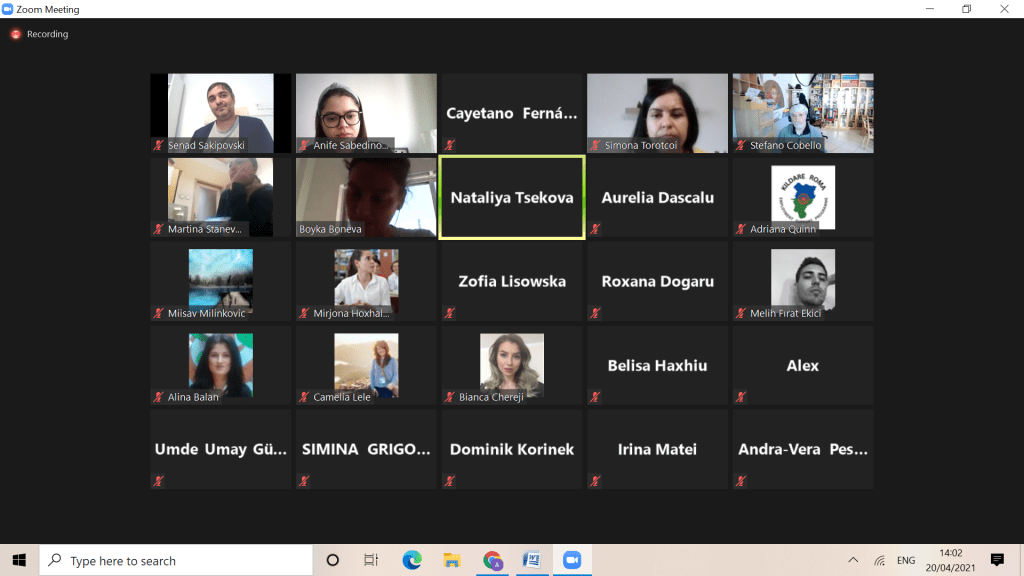
Participation: The event involved 66 citizens, including from 22 countries: 8 participants from Albania, 1 from Belgium,, 3 from Bulgaria, 1 from Bosnia and Herzegovina, 1 from Croatia, 5 from Czech Republic, 1 from France, 7 from Germany,6 from Greece, 1 from Hungary, 3 from Italy, 1 from Lithuania, 2 from Poland,1 from Portugal, 5 from Romania, 1 from Slovenia, 3 from Spain, 5 from North Macedonia, 1 from Montenegro, 6 from Serbia, 1 from Ireland and 2 from UK.
Location/ Dates: The event took place in online on 20 April 2021.
The event “Combating Antigypsyism and Multiple Discrimination in Roma Community” happened on 20 April 2021 online. Antigypsyism is a widespread reality in Europe, and it is often combined with historical intolerance against the Roma, poverty, marginalisation, exclusion, stigma or violence. While the fact of being Roma seems to be the most visible ground for discrimination, other grounds for example, sex, sexual orientation, gender identity or migrant status – can also play a role, so that the person is discriminated against on multiple levels.
The most dangerous is the institutional manifestation of Antigypsyism which has long historical root. Available informations are from 14th century, where Roma, today mostly the territory of Romania, were forced into bondage and slavery, lasted for 5 centuries. Later on, during different historic imperials this practice of Roma dehumanization has maintained such as: sterilization, deportation, imprisoning, prohibiting marriages, genetic predisposition to commit a crime etc. The most brutal and the most massive form has occurred during the WWII when approximately 500 000 Roma were killed by the Nazi regime.
Today significant parts of the Roma population continue to struggle with challenges we like to believe no longer exist in the EU. Intolerant attitudes and racism toward the Roma are pervasive throughout the Europe. There is no equality when discrimination persists, and it is impossible to combat discrimination effectively without tackling antigypsyism and improving the socioeconomic inclusion and participation of the Roma population.
The European Parliament and the Council of Europe , have reached a consensus that antigypsyism contributes to persistent Roma exclusion. As antigypsyism and exclusion form a vicious circle, they should be tackled together. Fighting discrimination and antigypsyism will contribute to the success of inclusion measures, which in turn will foster greater openness and acceptance in society. Fighting antigypsyism and promoting diversity and inclusion require the participation of society as a whole, Roma and non-Roma communities alike. They involve Roma empowerment and tackling mainstream attitudes and behavior.
Hate speech and hate crime also affect the Roma population disproportionately and several political parties across Europe use the Roma population as scapegoats for social and economic problems in their countries. This widespread rhetoric of hate makes the Roma even more vulnerable and marginalised. The recent resurgence of extremism targeting Roma demonstrates that antigypsyism continues to be a driving force of political populism. In addition, generally negative portrayal of Roma in mainstream media and online reinforces prejudices, stereotypes and racist attitudes.
The objectives of the conference are:
- Analyze the reasons and manifestation of the Antifypsyism
- Combat the scapegoating and hate against the Roma;
- To reflect on the role of civil society in tackling Antigypsyism, particularly through making coalitions
- to develop empathy for those experiencing discrimination
- To create a better understanding of what multiple discrimination is and how it affects Roma women, LGBT; young Roma etc.
Mainly the event was divided into 2 sessions. The first was named Combat AntiGypsyism and Multiple Discrimination in Roma Community gathered experts on Antigypsyis, media literacy, online and offline hate speech towards the Roma, expert on Human rights education particularly on Antigypsyism and Roma LGBT activist.
The panellist were:
Moderator Mr. Senad Sakipovski – President of Institute for Roma and Minorities Integration – Germany
Panellists
- Dr Caytano Fernandez, Spain, expert in hystorical Antigypsysim
- Dr. Torotcoi Simona, Global Teaching Fellow, Bard College Berlin, expert in Discrimination against the Roma in Education
- Dr. Biser Alekov, Phd Brussels, Roma LGBT activist
- Roxanna-Lorraine Witt, Director of save space e.V., Germany, expert in hate speech against the Roma
- Adem Ademi, European Roma Equality Network, Brussel, expert in institutional Antigypsyism
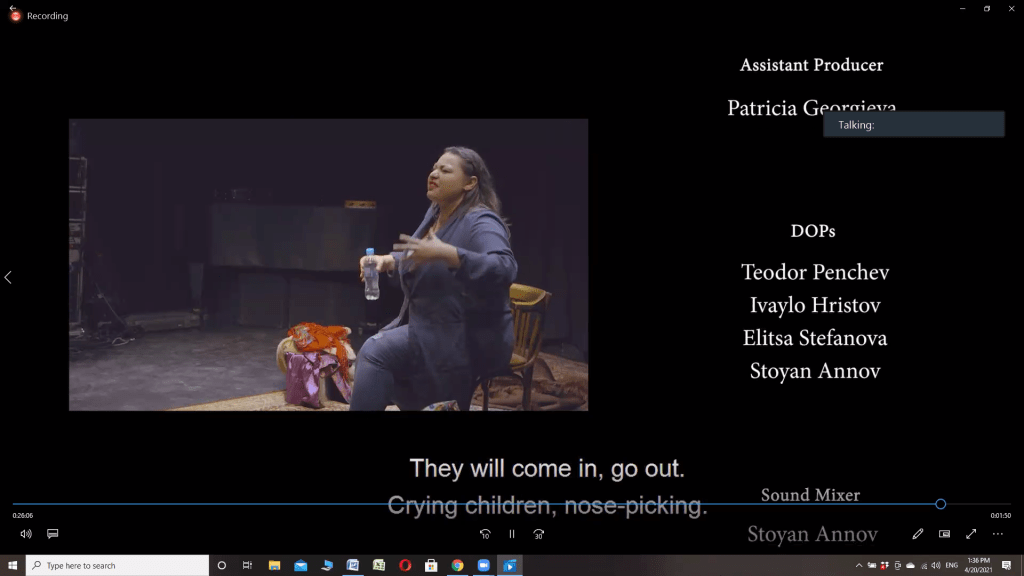
The second session was dedicated to the Short Movie: My Gypsy Road.
Thriller: https://www.youtube.com/watch?v=fY4MA2EOi0Q
An inspiring story about the winding road of the first Roma actress in Bulgaria, officially graduated from the National Academy for Theatre and Film Arts. From the everyday life’s challenges, to the sacrifices in the name of theater, and the trust in the great Roma cause – education for the ghetto. Nataliya Tsekova – THE WOMAN, THE ACTRESS, THE PERSON.
The main character, a Roma actress Nataliya Tsekova was present for the discussion. There was a fruitful debate which was linked with the previous presentations and discussion.




 Stop Roma Stigmatiyation